Showing posts with label coin collecting. Show all posts

Friday, June 19, 2009

2009 Lincoln Pennies

I have previously discussed the 2009 Lincoln penny, which features four new designs to celebrate President Abraham Lincoln's 200th birthday and the 100th anniversary of the first Lincoln penny. The designs on the 2009 penny will only be used this year - new designs will be featured on pennies in 2010 and during subsequent years.

The first 2009 penny design, featuring a design commemorating Lincoln's birth and early childhood in Kentucky, was released on February 12, 2009. I live in Chicago, IL, and I have yet to see any 2009 pennies having this first design. Apparently 634 million pennies having this design were minted, but I have yet to see one in circulation.

The second penny design, featuring a design commemorating Lincoln's formative years in Indiana, was released on May 14, 2009. I recently received pennies featuring this design as change at my local grocery store. I went straight to my bank after receiving those pennies in change and was able to purchase 10 uncirculated rolls of the 2009 pennies with the second design.

As far as I can tell, many people have been hoarding 2009 pennies. Collectors have been purchasing rolls of the 2009 pennies from banks and consumers receiving the 2009 pennies in change are also saving them. Demand for the 2009 pennies is very high and collectors have been selling 2009 pennies on eBay at prices above the 1-cent face value of the pennies.

The mintage for the 2009 pennies is far lower than it has been in years past. I have read that because the U.S. economy in mired in a deep recession, people having been using the change that they have accumulated over the years to either purchase goods or to deposit into their bank accounts. As a result, there are many more old coins in circulation right now than there has been in years past. Consequently, the U.S. Mint has been minting far fewer coins than it has in previous years.

The mintage of 2009 pennies is supposedly going to be maybe 25% of what it has been in recent years. The combination of relatively low mintage combined with the high demand by collectors for the 2009 pennies means that they are very hard to find. Anyone who has at least somewhat of a passing interest in coin collecting should seriously consider saving 2009 pennies if that person ever receives such pennies as change for a purchase.

Tuesday, September 23, 2008

New Designs for the 2009 U.S. Penny

In September 2007 I discussed proposed new designs for the 2009 Lincoln cent (a.k.a., the U.S. penny coin). The front side of the Lincoln cent will remain unchanged, continuing to show a profile view of Abraham Lincoln. The obverse side, however, will be changed to commemorate the 200th anniversary of Lincoln's birth. (2009 will also mark the 100th anniversary of the Lincoln cent - the first Lincoln cents were introduced in 1909.) This will mark the second time that the observe has been changed. Between 1909 and 1958, wheat stalks were shown on the observe side and the current design of the Lincoln Memorial has been shown on the obverse side since 1959.

There are going to be four new designs shown on the obverse sides of Lincoln cents in 2009, with a new design being introduced every three months. The first new Lincoln cent is scheduled to be introduced into circulation on February 12, 2009, Lincoln's birthday.

The first design shows a log cabin, representing the cabin in Kentucky where Lincoln was born. The second design depicts a young Lincoln reading a book while taking a break from working as a rail splitter in Indiana. The third design shows Lincoln as a young lawyer standing in front of the former Illinois state capitol building in Springfield, Illinois. The fourth coin depicts the half-completed U.S. Capitol dome, representative of Lincoln's order that construction of the Capitol continue during the Civil War as a symbol that the Union would survive.

Monday, May 19, 2008

The U.S. House of Representatives Voted to Change the Composition of Penny and Nickel Coins

The U.S. House of Representatives voted on May 8, 2008 to change the composition of penny and nickel coins to less expensive metals. As I have previously discussed, the U.S. Mint currently loses millions of dollars a year on minting costs associated with producing nickel and penny coins. Nickels currently contain 75% copper and 25% nickel and pennies contain about 97.5% zinc and 2.5% copper. Due to the enormous increase in value of commodities, such as nickel, copper, and zinc, over the past few years, the Mint has been losing money by producing these coins and then selling them to banks at face value. A penny currently costs about 1.26 cents to produce and a nickel costs about 7.7 cents to produce.

The U.S. Mint enacted a law making it illegal to melt down pennies and nickels in December 2006 to prevent people from hoarding pennies and nickels and melting them down to profit from the increased value of the metals in such coins. On May 8, 2008, the House of Representatives voted to change the composition of pennies to a copper-plated steel composition and nickel coins to primarily a steel-based coin. The new penny and nickel coins are both projected to cost less than their respective face values, saving the U.S. Mint millions of dollars annually.

The bill still has to make its way through Congress and be approved by the Bush administration. Apparently there are some objections to some of its current provisions, so it is unclear as to when the coin compositions will actually be changed, if at all.

Friday, February 29, 2008

The U.S. Treasury Secretary Would Like to Get Rid of Penny Coins

I have previously written about how I have been collecting U.S. nickel and pre-1982 penny coins because their the value of the metals in such coins (i.e., the "melt value") exceed the face values of those coins. [See my posts from February 2006, April 2006, and October 2006.]

Coinflationis an interesting website that I periodically visit because it gives the melt values of a number of coins currently in circulation, as well as the melt values of silver coins no longer in circulation, but which are fairly widely held by collectors. According to Coinflation, as shown in the image below (click on the image for a larger view) a pre-1982 copper penny has a melt value of about 2.55 cents (i.e., 255% of face value), a copper nickel has a face value of about 7.04% (i.e., 140.8% of face value), and a 1982-2008 zinc penny has a face value of about 0.711 cents (i.e., 71.1% of face value).

Given the rapid rise in the price of commodities such as copper and nickel metals, the U.S. Mint has been losing many millions of by making nickels and pennies. Even though zinc pennies currently have a melt value below their face value, when transportation and other miscellaneous manufacturing costs are taken into account, the Mint loses quite a bit of money making some 7-8 billion pennies each year.

Treasury Secretary Henry Paulson was recently interviewed and stated that he personally would like to get rid of the penny due to its minimal value and usefulness. However, Paulson concluded that it would not be politically doable at this time because the penny coin does have its fans.

Even if the penny coin is not eliminated anytime soon, it seems highly likely that the base metal compositions of nickel and penny coins will likely be changed to less expensive metals at some point in the near future, as I have previously speculated. The Bush administration is currently pushing to give the government the authority to change the metal content of all of the country's coins in order to save money.

If the government does pass legislation to change the metal contents of coins, I expect the Mint to quickly change the base metals of at least the U.S. nickel and penny coinage. If that happens, it is likely that collectors will eventually, over time, snap up much of the older coins currently in circulation. I personally don't want to see the penny coins go away, but I do think that changing the base metal content of U.S. coins would be a good idea so that the U.S. Mint doesn't have to lose money simply by making pennies and nickels.

Thursday, September 27, 2007

New Designs For The U.S. Penny Will Be Introduced In 2009 To Commemorate Lincoln's 200th Birthday

The U.S. Mint is changing the designs on the Lincoln penny in 2009 to commemorate the 200th anniversary of Abraham Lincoln's birthday and the 100th anniversary of the Lincoln penny. The face of the penny has remained the same since its introduction in 1909. The design on the reverse side, however, was changed in 1959 from wheat stalks to the current design of the Lincoln Memorial.

The U.S. Mint recently revealed that it will introduce four rotating designs on the 1-cent coin for 2009 that will depict different aspects of Lincoln’s life. Here are some of the designs being considered:


The commemorative coins will only be made in 2009; in 2010, news pennies will include a new permanent design.

I expect that the 2009 pennies will become collectors’ items, just like the 2004 and 2005 Westward Journey nickels have become. When 2009 rolls around, I will be sure to purchase a few rolls of the new pennies from my local bank branch.


*** Update - September 23, 2008 ***

The U.S. Mint revealed the four new designs for the U.S. penny in a ceremony on September 22, 2008. The four designs shown above in this post were merely among the proposed designs. The designs that are actually going to be used are discussed in a recent post I wrote discussing the new designs for the 2009 U.S. penny.

Friday, August 10, 2007

How to Collect Pre-1982 Pennies and Nickels

I have previously mentioned that I am collecting nickel coins and pre-1982 pennies because their intrinsic melt values (i.e., the commodity value of the metals comprising the coins) exceed their respective face value. According to coinflation.com, as of the market close on August 10, 2007, a U.S. nickel coin has a melt value of 6.34 cents (i.e., 26.88% above face value) and a pre-1982 penny has a melt value of about 2.42 cents (i.e., 142% above face value).

I am saving nickels and pre-1982 for their commodity value and because I passively enjoy coin collecting. The odds are that I'll never make that much money off collecting coins for their commodity value. To be perfectly honest, if I didn't enjoy collecting coins, this would probably be a waste of time.

I have seen people attempting to sell pre-1982 pennies for prices well above face value (and even above the melt value). This seems like a total rip-off to me, given the fact that pre-1982 pennies (and nickels) are still widely abundant in circulation. I know that many people are hoarding these coins, but don't forget that the U.S. Mint produced many billions of these coins that are still being used in commerce.

I personally save all of the nickels and pre-1982 pennies I receive in change, except for the ones that have gum on them or are extremely dirty. I also occasionally purchase rolls of pennies and nickels from bank branch offices. There is a bank branch office right across the street from where I live, so these rolls are easy to get.

I have purchase rolls of coins at face value from different bank branches and have never been hassled or charged a fee for doing so. I stopped purchasing rolls of pennies a long time ago because it was too much of a hassle to search through 50-penny rolls for pre-1982 pennies. However, every once in awhile I still purchase a few rolls of nickels. Once of the reasons why I like purchasing rolls of nickels is because I rarely receive and of the 2004 and 2005 "Westward Journey" commemorative nickels in circulation anymore. Luckily, however, I can usually find a few of the Westward Journey nickels in $2 rolls of nickels available at bank branches.

Friday, May 04, 2007

The Melt Value of U.S. Nickel Coins Is Still Increasing

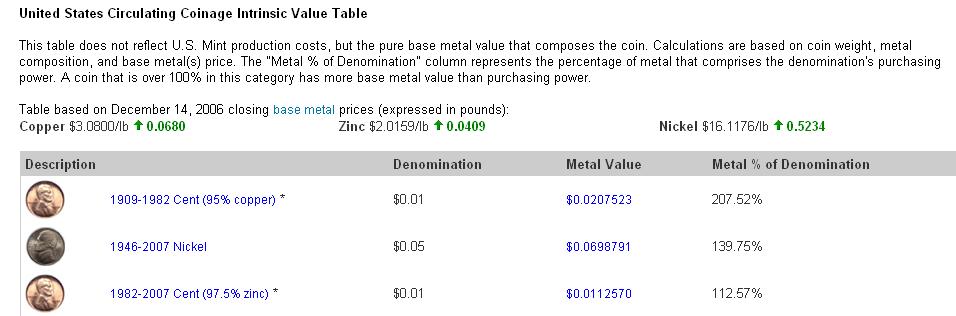
I have mentioned several times that I am collecting U.S. nickel coins and copper pre-1982 pennies because the value of the physical base metals from which they are formed (i.e., the "melt value") exceeds their respective face values. Back on December 14, 2006, I mentioned that the metal value of pre-1982 pennies was 2.0752 cents (207.52% of face value), post-1982 zinc pennies had a metal value of 1.1257 cents (112.57% of face value), and nickels had a metal value of 6.9879 cents (139.75% of face value).

The value of zinc (the primary component of post-1982 pennies) has decreased about 13% since then. However, the values of raw copper and nickel metal have risen substantially since mid-December, with copper increasing about 22% and nickel increasing almost 49%. These metals have been soaring during the U.S. commodities boom that has been going on during the past several years. The cause of this boom is most likely due to a continuing weak U.S. dollar and rising demand for raw materials from fast-growing emerging markets such as China and India.

As shown in the chart below (taken from Coinflation.com - click on the image for a larger view), the metal value of pre-1982 pennies is now 2.5237 cents (252.37% of face value), post-1982 zinc pennies have a metal value of 0.9953 cents (99.53% of face value), and nickels have a metal value of 9.7226 cents (194.45% of face value).

With the melt values of these metal substantially exceeding the face value for nickels and at about parity with face value for post-1982 pennies, the U.S. Mint is losing many millions of dollars each year by making these coins with their current compositions. As such, it is practically a guarantee that the U.S. Mint will change the base metals of these coins within the next couple years, at which point the current pennies and nickels in circulation will become collectors' items hoarded just like old silver coins were hoarded when the U.S. Mint abandoned the use of silver in its coins.

Saturday, April 28, 2007

Update on the 2007 Presidential Dollar Coins

Back in February I wrote about how the new Washington Presidential dollar coins were hard to find. Since I wrote that post, I returned to bank branches on several occasions and was finally able to obtain a $25 roll of these dollar coins. I am going to hold on to the roll and do not plan on opening the roll to see if there are and mis-strikes or error coins in the roll at this time.

I have yet to see any of the new dollar coins in circulation at any place other than at banks. It's pretty clear to me that people are hoarding these coins without any intention of using them as currency. I expect to eventually receive some of these coins in change at a postal stamp vending machine, but I would be very surprised to see them anywhere else other than at a coin shop.

A few months ago there were many articles being published about the new dollar coins and how they last far longer than paper dollars and that the maintenance cost of a dollar coin supply is therefore far less than that of a paper dollar coin supply. Many of these articles hinted at the possibility that these coins might eventually become widely used by shoppers. I honestly cannot see that ever happening. Paper dollars are far easier to carry in a wallet and take up less space and weigh far less. Dollar coins will probably never be viewed at anything other than a novelty unless or until the government abolishes paper dollars.

Wednesday, February 28, 2007

The New Presidential Dollar Coins Are Hard To Find

As I have posted previously, I collect pre-1982 pennies and all nickels because their intrinsic values (i.e. melt values) exceeds their respective face values. As of today, February 28, 2007, a pre-1982 penny has an intrinsic value of about 1.8254 cents (i.e., 182.54% of its face value) and a nickel has an intrinsic value of about 7.80 cents (i.e., about 156.01% of its face value). (See Coinflation.com.) I wouldn't call myself a serious collector, although I do save these coins when I receive them in change.

I enjoy collecting coins because coins are piece of American history. From a certain point of view they are small and readily accessible pieces of art. As such, I was really looking forward to the unveiling of the new Presidential dollar coins which were released on February 15, 2007. The first Presidential dollar coin contains a picture of the first president of the United States, George Washington.


Unfortunately, the new dollar coins are hard to find. The U.S. Mint is supposedly making 300 million of them, but I have yet to see one of them. I have been to three bank branches over the past three weeks, but each one has been out of the new coins. I was informed today that the branch I most recently visited had received a big box of the coins but that they were quickly snapped up by customers. I assume that this means that some people are hoarding a lot of these coins. I generally don't have a problem with people hoarding coins, as I do the same. However, I really wish banks would set limits on how many of these coins they sell to individual customers, as it doesn't seem right that someone can purchase hundreds of dollars of the new coins and then turn around and sell them on eBay or in a coin shop at a premium price.

Thursday, December 14, 2006

The U.S. Mint Is Implementing A New Rule Abolishing the Melting of Pennies and Nickels

I have mentioned several times over the past year that I am hording pennies and nickels. We are currently in the midst of a commodities boom and the value of precious metals and non-precious metals (such as those used in current U.S. coins) has soared for the past 2 or 3 years. There are several reasons for the soaring prices that I will not discuss in detail here in this post (although I may discuss it in a future post), but among the chief reasons for this boom is the strong global demand for metals due to strong worldwide economic growth, as well as a devaluation of the U.S. dollar by the Federal Reserve that has increase the U.S. dollar value of commodities.

The value of the metals within several U.S. coins, including pennies and nickels, now exceeds the face value of the coins, as shown in the picture below that I acquired from coinflation.com, the best website I've seen for determining the intrinsic metal of various coins (click on the picture for a larger view). As one can see, the metal value of pre-1982 pennies is now 2.0752 cents (207.52% of face value), post-1982 zinc pennies have a metal value of 1.1257 cents (112.57% of face value), and nickels have a metal value of 6.9879 cents (139.75% of face value).


To realize the intrinsic metal value of these coins, one would need to melt them down to separate out the respective valuable metals. Up until yesterday, my understanding was that this practice was not illegal. I've never done so myself or heard of anyone actually doing so, but I read somewhere that this practice would not be prohibited.

The U.S. Mint has apparently been losing money by making pennies and nickels over the past year as it pays more for the metals used to make the coins that it receives in return when it sells the coins at face value to banks, etc. As of today, the U.S. Mint has made it illegal to melt down pennies and nickels. It is also illegal to transport more than $100 worth of pennies and/or nickels out of the country unless it is for legitimate coinage purposes. The penalty for violation of this new rule is a penalty of up to five years in prison and a fine of up to $10,000 for people convicted of violating the rule.

In case anyone had any doubts about whether collecting pennies and nickels is worthwhile, the U.S. Mint's implementation of the new rule should quell such doubts. It's only a matter of time until the U.S. Mint changes the metal composition of pennies and nickels to include less expensive metals, a move that would likely increase the collectible value of current pennies and nickels.

Tuesday, October 24, 2006

I'm Still Saving U.S. Nickel Coins

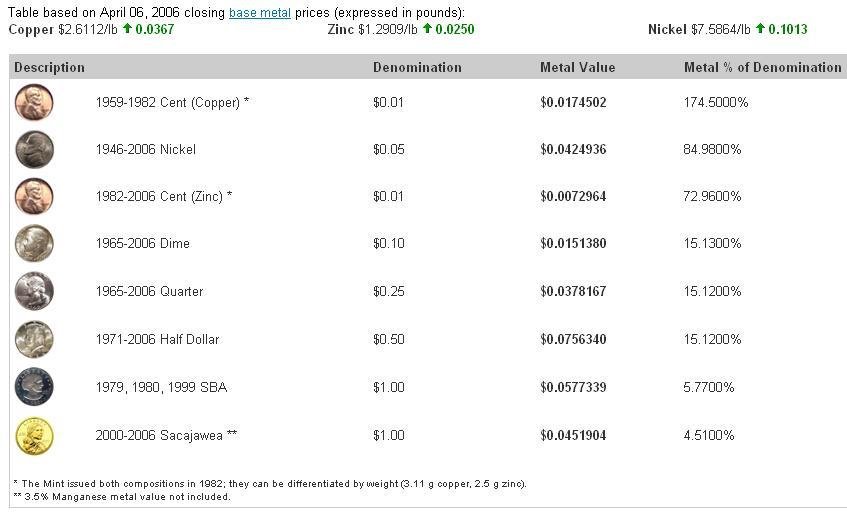
Back on April 6, 2006 I wrote that I was saving all of the U.S. nickels I acquire in change because the melt value of nickels was about 4.24936 cents, or 84.98% of the 5-cent face value ofthe U.S. nickel coin. Almost all U.S. nickel coins made between 1938 and 2006 contain 75% copper and 25% nickel (the exception was during 1942-1945 when almost all nickels contained silver and manganese instead of nickel). At the time of my previous post, nickel was trading at $7.7564 per pound and copper was trading at $2.6112 per pound.

It's a good thing that I've been saving nickels because the value of nickel and copper has soared since April. One pound of nickel is now worth $15.4909, nearly twice what it was a mere 6 months ago. Copper has risen a slightly less impressive 31%, with one pound of copper now trading for $3.4302 per pound. The melt value of U.S. nickel coins is now about 7.10471 cents, or 142.09% of its 5 cent face value. The melt value of U.S. nickel coins has therefore risen about 67% since April.

If the value of copper and nickel remains strong, it's only a matter of time until everyone starts hoarding U.S. nickel coins, just like the U.S. population did in the 1960 when quarters used to be made of silver and the price of silver rose so much that the value of the silver in quarters exceeded the 25-cent face value of the quarters. Accordingly, I continue to recommend that people saved their nickels.

FYI, numismatic news has a great article about hording coins.

Thursday, April 06, 2006

Since Commodities Are Soaring, I am Saving Nickels and Pre-1982 Pennies

The price of copper has continued to soar. As of the commodity market close today, one pound of copper was trading for $2.6112. The price of nickel and zinc has also been soaring - as of today's market close, one pound of zinc was trading for $1.2909 and one pound of nickel was trading for $7.7564.

As I mentioned in a previous post, I have been saving my pre-1982 pennies for several months now because pre-1982 pennies contained 95% copper and copper has risen so much in value. A pre-1982 penny now contains about 1.745 cents worth of copper in it. That is, the copper in a pre-1982 penny is worth 74.5% more than the face value of a penny.

Nickels also contain a large percentage of copper. Almost all nickels made between 1938 and 2006 contain 75% copper and 25% nickel (the exception was during 1942-1945 when almost all nickels contained silver and manganese instead of nickel). The current commodity value of the metals in a nickel is about 4.24936 cents, or 84.98% of the 5-cent face value of a nickel. Given how well commodities have been performing, it seems likely that the prices of copper and nickel will continue to rise to the point at which the metal in the nickel are worth more than the face value of the nickel. I have therefore been hording the nickels I get in change. Also, because the design on all nickels made from 2006 on into the future is different than the design on older nickels, I believe that nickels from 2005 and earlier will also eventually have a numismatic value exceeding five cents, regardless of the metal value contained within them.

Here is an image captured from coinflation.com showing the current intrinsic values of various coins in circulation based on the value of the metals contained within those coins:

Wednesday, February 01, 2006

Save Your Pre-1982 Pennies

This post has nothing to do with the stock market, but I think it is interesting nonetheless. Prior to 1982 almost all pennies minted by the U.S. mint contained about 95% copper and 5% tin and zinc.* During mid-1982 the U.S. mint changed the metallic compisition of the pennies to about 99.2% zinc and 0.8% copper. All pennies minted since 1982 have less than 1% copper.

The reason why the composition was changed is because during the early 1980s the price of copper kept rising and the total value of the copper metal in each penny was apporoaching the one cent face value of the penny. Accordingly, if the value of copper had kept rising, the U.S. Mint would have been losing money by producing more of the 95% copper pennies.

As you are probably aware, the prices of commodities have been soaring over the past few years. The price per pound of copper was recently about $2.33. At $2.33 per pound, the value of the copper in most pre-1982 pennies is about 1.45 cents, 45% more than the face value of those pennies, as discussed in this article.

For those who can afford to do so, it might be a good idea to start hoarding any pennies you receive in change that are from before 1982. At some point in the future those pennies might be worth several cents apiece to metal refiners willing to melt them down for the copper contained within them.

At Coinflation.com, you can determine the instrinsic value of various coins in circulation over the past 100 years or so.

*1943 was the exception when steel pennies were minted to conserve copper necessary for in America's WWII efforts.